 685 738 325
Nutrition
Overweight and obesity in dogs and cats: how to tell, and what to do
21 July 2026 · Updated on 24 August 2026

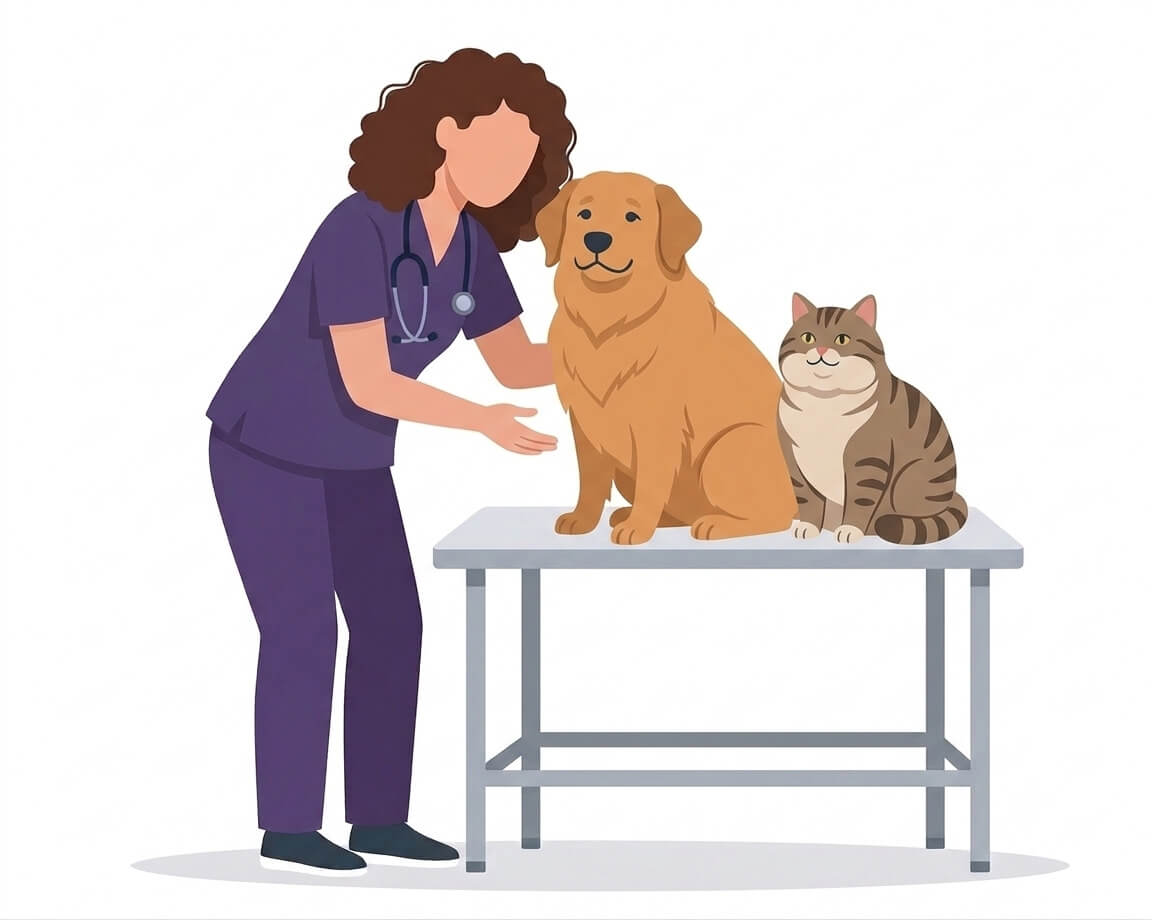
“He’s a bit chubby, but that just makes him more cuddly.” “She’s always been like that, big-boned.” “He eats so well, I couldn’t put him on a diet.” Phrases like these come up daily in any vet clinic, and they don’t reflect neglect on anyone’s part: they reflect just how normalised excess weight in dogs and cats has become visually, to the point that many owners simply don’t recognise it for what it is.
And it’s by far the most common nutritional problem seen in daily practice. Various veterinary sources put the prevalence of overweight or obesity at more than half of all dogs and cats, well ahead of any other chronic condition. The reason it goes so unnoticed isn’t that it’s hard to spot — it’s that the visual baseline for “normal” has gradually shifted, as excess weight has become the norm rather than the exception.
This article isn’t about placing blame on anyone. It’s about giving you the tools: how to get an orientative read on whether your dog or cat is overweight, why it happens — which is almost never just “eating too much and moving too little” — what real health risks it carries, and how to approach weight loss safely, always alongside your vet.
What the Body Condition Score is, and why it matters more than the scale
Weight in kilos, on its own, doesn’t tell you much. A 5 kg cat can be at an ideal weight or clearly overweight depending on their size, breed and build — the same goes for the difference between a chihuahua and a German shepherd. That’s why vets don’t rely on the scale alone, but on the Body Condition Score (BCS).
The BCS is a visual and hands-on assessment of the animal’s body — ribs, waist, abdomen and fat deposits — usually on a 9-point scale:
- 1-3: the animal is below their ideal weight, with ribs, spine and hip bones very prominent.
- 4-5: ideal body condition. Ribs are easily felt under a thin layer of fat, there’s a visible waist, and the abdomen tucks up slightly.
- 6-9: excess weight, increasing in degree. A BCS of 6-7 already indicates clinically relevant overweight; 8-9 indicates obesity, with ribs difficult or impossible to feel and no visible waist.
As a general guide, overweight is usually considered a body weight 10-20% above ideal, and obesity more than 20% above ideal. These are orientative figures, not an exact rule — what really matters in the consultation room is the BCS assessed by the vet, together with how the animal’s weight is trending over time.
The body condition score in one table
| BCS (1–9 scale) | What you feel and see | Interpretation |
|---|---|---|
| 1–3 | Ribs, spine and hip bones very prominent | Below ideal weight |
| 4–5 | Ribs easily felt under a thin layer of fat, visible waist, tucked abdomen | Ideal body condition |
| 6–7 | Ribs hard to feel, poorly defined waist | Clinically relevant overweight (10–20% above ideal weight) |
| 8–9 | Ribs hard or impossible to feel, no waist | Obesity (more than 20% above ideal weight) |
The percentages are indicative. What counts in the consulting room is the BCS assessed by the vet alongside how the weight changes over time.
How to check at home if your dog or cat is overweight
First things first: what follows is an orientative check, meant to help you decide whether it’s worth bringing up at the next visit — not a diagnosis. A reliable assessment is done by your vet, who can also rule out medical causes and calculate a real target weight for your pet.
That said, there are three simple checks you can do at home:
- Feel for the ribs. Place your thumbs along the animal’s spine and your open hands over the sides, across the rib cage. In an animal with a healthy body condition, you should be able to feel the ribs relatively easily, similar to feeling the knuckles on the back of your hand. If you have to press firmly to feel them, or can’t feel them at all, that suggests overweight.
- Waist viewed from above. Looking at the animal standing from above, there should be a clear narrowing behind the ribs — an “hourglass” shape. If the outline is straight, or even wider at the abdomen, that’s a sign of overweight.
- Abdominal profile from the side. Viewed from the side, the abdomen should tuck up slightly just behind the rib cage. An abdomen that sags, or forms a flat or downward line, usually points to excess abdominal fat.
If any of these three checks leaves you unsure, it’s a good moment to mention it at the next visit rather than waiting until it becomes obvious to the eye.
Why is my pet overweight (it’s not always just “eating too much”)
It’s tempting to reduce overweight to a simple calories-in, calories-out equation, and in many cases that imbalance is indeed behind the problem. But several factors play a role beyond the amount of food, and they’re worth keeping in mind:
- Indoor living. Animals living in flats, especially without regular access to outdoor space, tend to have a naturally lower activity level than those living in houses with a garden or with daily access to large open spaces.
- Breed predisposition. Some breeds — in dogs, for example, Labradors or beagles; in cats, breeds like the British Shorthair — have a greater genetic predisposition to gaining weight easily.
- Age. Metabolism slows down with age, and a senior animal still eating the same amount as when they were a young adult, while moving less, tends to gain weight progressively.
- Spaying/neutering. Spaying and neutering change an animal’s metabolism, lowering their energy needs. It’s not that neutering “causes” weight gain directly — rather, a neutered animal generally needs fewer calories than before the procedure, and if the portion isn’t adjusted, excess weight follows.
- Underlying illness. Some conditions, such as hypothyroidism or Cushing’s syndrome (hyperadrenocorticism) in dogs — which often comes with a characteristic pendulous or “bloated” abdomen due to fat redistribution and weakened abdominal muscles — can drive weight gain, or mimic it, even with an apparently adequate diet. That’s why, when overweight doesn’t respond to the usual adjustments, your vet may look to rule out medical causes before assuming diet alone is to blame.
Understanding this matters because it changes the approach: it’s not just about “eating less,” but about identifying which combination of factors is behind that particular animal’s excess weight, in order to design a plan that actually works.
Health risks of overweight and obesity
Excess weight isn’t just a cosmetic issue: it’s an active risk factor for several serious health problems, and it worsens the prognosis of many conditions an animal may already have. Among the most relevant:
- Arthritis and joint problems. Excess weight overloads joints that already bear the animal’s body weight with every movement, speeding up joint wear and worsening pain in animals that already have arthritis.
- Cardiovascular and respiratory disease. The heart and lungs work under greater strain in an obese animal, which can trigger or worsen cardiorespiratory problems.
- Diabetes. Excess weight worsens insulin resistance, especially in cats, and is one of the most significant modifiable risk factors for feline diabetes.
- Higher surgical and anaesthetic risk. An obese animal carries more risk in any procedure requiring anaesthesia, from a dental cleaning to major surgery.
- Infections, especially skin infections. Skin folds associated with excess fat trap moisture and cause irritation, increasing the risk of dermatological infections.
- Shorter life expectancy. Various long-term follow-up studies show that animals that stay overweight live, on average, fewer years than those kept at their ideal weight.
This is also one of the reasons obesity connects directly with managing other chronic conditions: as we explain in our article on feeding dogs and cats with chronic illness, excess weight isn’t just a problem on its own — it’s a factor that worsens the prognosis of conditions like kidney disease, diabetes or joint disease.
How to approach weight loss safely
Once overweight has been identified, the natural temptation is to cut portions on your own, by eye, until you see results. That’s exactly what you shouldn’t do, for two reasons.
First, because a poorly calculated calorie restriction can create nutritional deficiencies, even while the animal keeps losing weight. Second, and more importantly, because losing weight too fast can be harmful to the animal’s health. This is especially critical in cats, where a sudden calorie restriction can trigger hepatic lipidosis, a serious liver condition that occurs when a cat’s body mobilises fat too quickly for energy.
As a general reference, veterinary literature usually places a safe rate of weight loss at around 1-2% of body weight per week in dogs, and 0.5-1.5% in cats. These are orientative ranges, not a target to chase on your own — the exact pace within that range, and whether it needs adjusting, depends on how the animal is actually responding at each weight check, and it’s your vet who assesses that at every review.
So, any weight loss plan should:
- Be designed with your vet, who will calculate a realistic target weight and a safe rate of loss for that particular animal, taking into account their age, health status and activity level.
- Be based on a specific feeding plan, not just cutting back on the usual food — doing that alone often compromises the intake of other essential nutrients.
- Include regular follow-up, with weight and BCS checks at regular intervals to adjust the plan based on how the animal is actually responding, not just what was planned on paper.
- Be paired with tailored physical activity, whenever the animal’s health allows for it, as part of the plan rather than a substitute for it.
Prevention from puppyhood or kittenhood
The best time to prevent overweight is before it appears, and that starts well before adulthood. A puppy or kitten that’s overweight during their growth stage is far more likely to carry that problem — and the habits behind it — into adulthood, and excess weight during growth can also affect bone and joint development.
Setting up portions adjusted to the animal’s age and weight from the start, keeping treats and extras between meals under control, and encouraging an appropriate activity level are habits that, kept up from puppyhood or kittenhood, make it much easier for excess weight to never take hold in the first place.
Weight and BCS checks should be a routine part of every vet visit throughout an animal’s life, not something addressed only once it’s already obvious to the eye. If you want to know how often you should be bringing your pet in for these kinds of checks, we cover it in detail in how often should your pet visit the vet.
Frequently asked questions
Is my pet overweight if I can’t feel their ribs?
It’s one of the most reliable signs for an orientative check at home. If, running your hands along your dog’s or cat’s sides with moderate pressure, you can’t feel the ribs relatively easily, it’s quite likely they carry some degree of excess weight. It’s not a diagnosis on its own, but it’s a reasonable reason to bring it up with your vet at the next visit.
Does spaying or neutering cause weight gain?
Spaying or neutering doesn’t cause weight gain directly, but it does lower the animal’s energy needs by changing their metabolism. If the same portion is kept up after the procedure, progressive weight gain is common. That’s why it’s worth reviewing and adjusting the diet after spaying or neutering — not because the procedure itself “causes” weight gain.
How long does it take to lose weight safely?
It depends on the degree of overweight, the species and the animal’s health status, so there’s no single timeframe that applies to every case. What matters isn’t speed but making sure the loss is gradual and supervised: too fast a pace, especially in cats, can be harmful to their health. Your vet can estimate a realistic timeframe based on the target weight calculated for your pet.
Does “light” food work on its own?
Not necessarily. A food formulated as “light” or for weight control can be a useful tool within a plan, but on its own it doesn’t guarantee weight loss if the amount given isn’t properly adjusted, if it’s combined with uncontrolled treats or extras, or if it isn’t paired with adequate physical activity. The result depends on the whole plan, not just the type of food chosen.
A tailored weight plan, not a generic diet
Spotting excess weight early — rather than waiting until it’s obvious to the eye — is probably the single intervention with the greatest real impact on your pet’s long-term health and quality of life. And approaching it properly, gradually and under supervision, is what makes the difference between a plan that works and one that gets abandoned after a few weeks.
At Rovira Veterinary Clinic we offer dedicated nutrition consultations to assess your dog’s or cat’s Body Condition Score and design a weight management plan tailored to their specific situation. If you think your pet may be overweight, or simply want to confirm their current weight is right for them, book an appointment and we’ll take a look together.
Sources
Do you have any questions about your pet?
Book an appointment