
 685 738 325
Dermatology
Itching and skin allergies in dogs and cats: the most common causes and when to worry
23 July 2026 · Updated on 24 August 2026

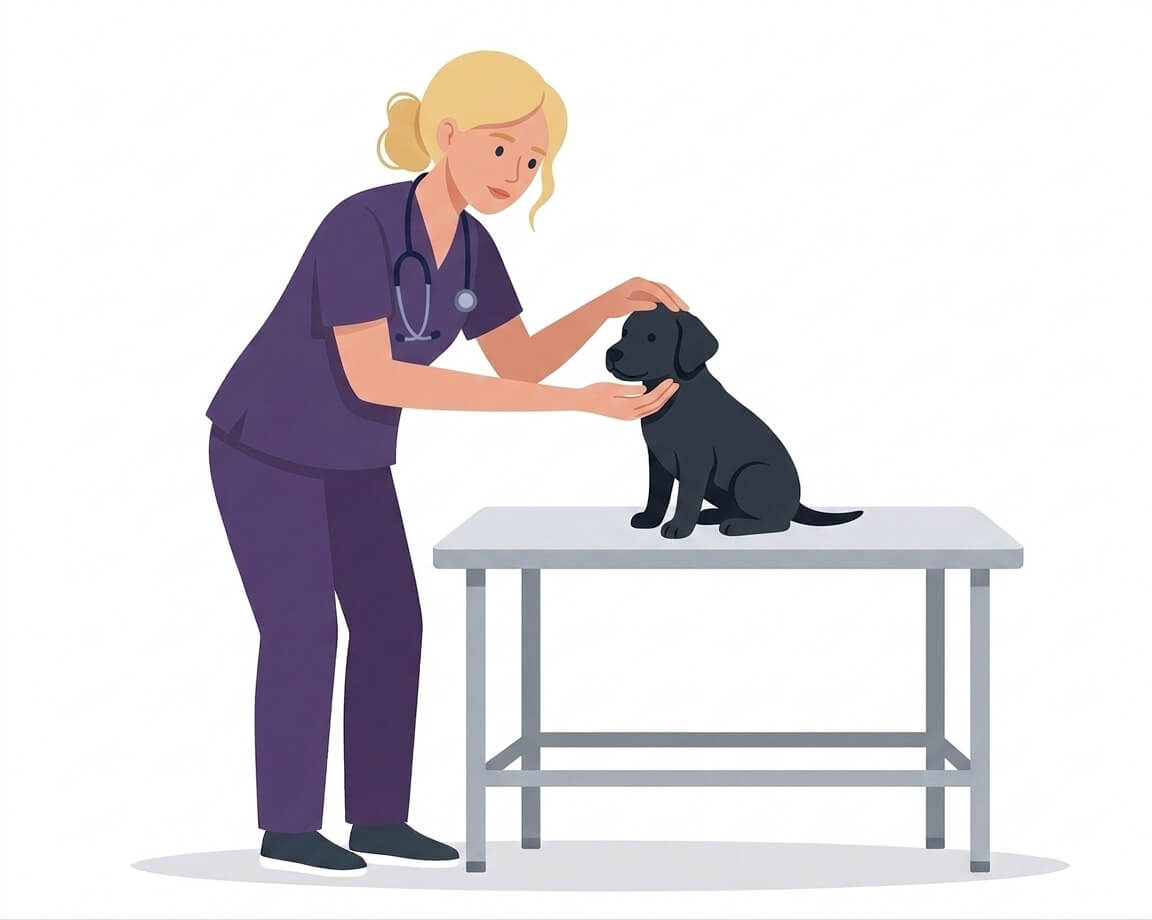
A dog that scratches an ear a couple of times before settling down, or a cat that grooms itself after a meal, is nothing to worry about. Scratching, licking and shaking the head are all part of the normal repertoire of any healthy animal. It’s hygiene, it’s exploration, it’s a way of relieving a one-off bite that goes away on its own within minutes.
The problem starts when that occasional gesture becomes a habit. When does that happen? When the scratching happens several times a day, always concentrates on the same areas, interrupts sleep or play, or leaves something visible behind — reddened skin, patchy or thinner fur, a scab that wasn’t there the week before. At that point it’s no longer an isolated gesture. This is pruritus: the veterinary term for itching that has become persistent. And it’s almost always a sign that something in the skin — or in the immune system protecting it — isn’t working the way it should.
This article brings together the most common causes of itching and skin allergies in dogs and cats, why some pets show it far more obviously than others, and how a diagnosis is reached. And above all: when that itching stops being “just something they do” and becomes a reason to see the vet.
The 3 most common causes of itching in dogs and cats
When a dog or cat develops chronic itching — meaning it persists or keeps coming back over weeks or months — the cause is almost always one of these three, or a combination of them. They aren’t equally common and don’t behave the same way in each species. But knowing them upfront helps you understand where the vet is likely to start.
Atopic dermatitis (environmental allergy)
This is the most common cause of chronic itching in dogs. In cats the equivalent condition is known as feline atopic syndrome. It’s a predisposition — largely genetic — to develop a hypersensitivity reaction to substances in the environment that, in an animal without that predisposition, would go completely unnoticed: grass and tree pollens, house dust mites, environmental mould spores or, less commonly, other animals’ dander.
In dogs it usually appears in young animals, typically before three years of age. It often follows a seasonal pattern at first — flaring up in spring, for example, if the main trigger is pollen — before becoming perennial, present all year round, as the animal becomes sensitised to more allergens over time. The areas most typically affected are the paws (especially between the toes), the face, armpits, groin, base of the tail and abdomen. And it’s very characteristic for it to show up as recurrent otitis: ear inflammation episodes that keep coming back despite one-off treatment.
In cats, feline atopic syndrome is harder to pin down. The age of onset is more variable and less predictable than in dogs, and it frequently presents as non-seasonal from the start, without flare-ups tied to a particular time of year. That, combined with more subtle signs (more on this below), means it tends to take longer to connect the picture with an environmental cause in cats.
Food allergy
This is a hypersensitivity reaction to one or more specific proteins in the diet. Chicken, beef, dairy or fish are among the most common, although it can be practically any ingredient the animal has been repeatedly exposed to. Unlike a digestive intolerance, here the immune system reacts to the protein as if it were a threat, and that reaction shows up mainly in the skin.
It’s proportionally more common in cats than in dogs. Clinically it can be indistinguishable from atopic dermatitis: the same itching, similar affected areas, the same pattern of recurrent otitis or infections. The main difference is that food allergy can appear at any age — even in animals that have eaten the same food for years without any problem — and sometimes it comes with digestive symptoms, such as soft stools or occasional vomiting. Though not always.
The only reliable way to confirm it is a supervised elimination diet: a food or homemade diet formulated with a protein source the animal hasn’t eaten before (novel protein) or with hydrolysed proteins — broken down so the immune system doesn’t recognise them. It’s kept strictly, with no treats or extras outside that diet, for several weeks. This isn’t a food switch done by trial and error at home. The recommended duration is usually around 8 weeks in dogs and up to 12 in cats, because skin improvement takes longer to show than digestive improvement. Cutting the process short is the most common mistake, and the one that leads to wrong diagnoses.
Flea allergy dermatitis (FAD)
This is a hypersensitivity reaction to the proteins in flea saliva, not to the flea itself. That explains something that often puzzles pet owners: an animal with FAD can develop intense, widespread itching after just one or two bites, without a single flea in sight. The insect bites, injects saliva and moves on — or the animal has already licked away the evidence — long before the owner gets a chance to check.
It’s especially common in the lower back and base of the tail, thighs and abdomen. The lesions are quite characteristic: small raised scabs in dogs, or eosinophilic plaques and “granite-like” skin over the back in cats. Very little flea exposure is enough to trigger a flare-up, so constant, uninterrupted external parasite prevention — not just during the warmer months — is the most effective control measure. If you’d like to go deeper into building a complete parasite prevention plan, we cover it in our guide on internal and external parasite prevention in dogs and cats.
Why itching in cats is harder to spot than in dogs
In dogs, itching is usually fairly easy to identify. The animal scratches with a paw, bites at one specific spot, rubs against the sofa or the carpet. It’s a visible behaviour most owners recognise without much difficulty, even if they take a while to act on it.
In cats, the same underlying problem tends to show up in far more discreet ways, which is why so many feline allergies go unnoticed for months. Instead of obvious scratching, the most common signs are:
- Overgrooming (excessive licking): the cat licks the same areas — belly, thighs, flanks — over and over until the fur is noticeably shorter or the area becomes bald, often without any visible wound for a long time. Many owners read this as “a very clean cat,” not as a symptom.
- Self-induced alopecia: symmetrical hair loss, typically on the belly and inner thighs, caused by the repetitive licking itself rather than by spontaneous shedding.
- Facial and neck pruritus: scratching at the face, neck or behind the ears, sometimes intensely enough to cause small self-inflicted wounds.
- Eosinophilic granuloma or skin plaques: inflamed lesions, sometimes ulcer-like in appearance, typically on the upper lip or the abdomen.
- Non-specific behaviour changes: some cats with itching don’t lick obviously at all, but become more irritable, avoid being touched in certain areas, or spend more time hiding.
The result: a dog with atopic dermatitis usually gets to the vet relatively soon because the scratching “shows”. Many cats with exactly the same underlying problem go undiagnosed for months or years, simply because no one identified the excessive licking for what it really was. Itching.
Secondary infections: when itching gets complicated
Ectoparasites (fleas, mites such as those responsible for mange) and skin infections caused by bacteria — typically Staphylococcus — or yeasts such as Malassezia are a very common cause of itching. But in most chronic cases they don’t show up as an isolated problem: they’re a complication of an underlying allergy that hasn’t been treated, or has only been partly treated.
The mechanism is fairly direct. Atopic dermatitis and food allergy disrupt the skin barrier — the layer of skin that normally acts as a shield against microorganisms — and throw off the skin’s natural microbial balance. With that barrier weakened, bacteria and yeasts that coexist harmlessly on healthy skin start to overgrow. And that overgrowth, in turn, causes more itching. It’s a self-feeding cycle: the allergy weakens the skin, the infection takes advantage of that weakness, and generates extra itching that adds to — and is often confused with — the itching from the original allergy.
This is why a dog or cat with an untreated underlying allergy can have a history of “recurring ear infections” or “skin infections that come and go with antibiotics”. These aren’t new problems each time. It’s the same underlying cause showing up again and again.
How the cause of an allergy is diagnosed
Diagnosing chronic itching generally follows a logical order of elimination. There’s no single test that gives an immediate answer:
- Rule out parasites. This is always the first step, even if the animal is on parasite prevention, because some mites are hard to detect and an inadequate antiparasitic schedule can leave protection gaps. Vets typically rely on skin scrapings, trichograms (examining hair under a microscope) or tape-strip cytology — the latter especially useful in cats, where mites such as Demodex gatoi or Cheyletiella can be missed on a conventional scraping — and, in many cases, a therapeutic trial with a broad-spectrum antiparasitic simply to confirm parasites aren’t the cause.
- Rule out or treat secondary infections. If there are signs of bacterial or Malassezia infection — odour, pustules, greasy or flaky skin — they’re identified through cytology (a sample taken with tape or a swab and examined under a microscope) and treated before investigating further, because an active infection can mask or exaggerate the underlying picture.
- Assess atopic dermatitis versus food allergy. With parasites and infections already ruled out or under control, and if the itching persists, the vet assesses the pattern of age, seasonality and affected areas to decide how to proceed. Since these two causes can produce a practically identical clinical picture, an elimination diet is often built directly into the diagnostic process, not just used as treatment.
- Supervised elimination diet, if a food component is suspected: a strict protocol lasting several weeks with a novel or hydrolysed protein source, ideally followed by a food challenge — reintroducing the original diet — to confirm symptoms return, the only way to confirm a food allergy with certainty.
- Allergy testing (intradermal or blood-based), only once atopic dermatitis has been confirmed, and usually with a specific goal: identifying the particular environmental allergens the animal reacts to, especially if a tailored immunotherapy (allergy vaccine) is being considered.
It’s a process that can take weeks. That’s exactly why “trying things” at home on your own — switching food without a proper protocol, using human antihistamines, applying shampoos without guidance — rarely solves the problem. And it often complicates the later diagnosis, because it masks symptoms the vet needs to see clearly.
Signs it’s time to see the vet
You don’t need to wait until the skin is visibly damaged to book an appointment. These are the signs that the itching is no longer a one-off and deserves a proper assessment:
- Scratching, licking or biting happens several times a day or interferes with the animal’s normal sleep and activity
- Redness, scabs, wounds from scratching or patchy hair loss appear
- You notice a bad smell on the skin or in the ears, or the animal shakes its head frequently
- The coat has become thinner, or the animal has clearly shorter patches of fur from excessive licking
- There have been repeated episodes of ear infections, skin infections or antibiotic treatments that improve and then come back
- The itching keeps getting worse week after week, instead of staying stable or improving
None of these signs on their own is cause for immediate alarm. But the more of them that add up, and the longer they’ve been present, the sooner it’s worth stepping in. There’s no definitive cure for atopic dermatitis. There are, however, effective ways to control the itching, reduce flare-ups and significantly improve the animal’s quality of life over the long term. That’s only achieved with a proper diagnosis, not improvised fixes.
Frequently asked questions
When does my dog or cat’s scratching stop being normal?
Occasional scratching is normal. It stops being normal when it happens several times a day, always concentrates on the same areas, interrupts sleep or play, or leaves something visible behind: reddened skin, shorter hair, scabs. That persistent itch is called pruritus and almost always means something in the skin or the immune system is not working as it should.
What are the most common causes of itching in dogs and cats?
The three most common are atopic dermatitis (environmental allergy), food allergy and flea allergy dermatitis (FAD). Secondary bacterial or Malassezia infections frequently pile on top, amplifying the itch and complicating the picture if they are not treated.
Is there a single test that tells me what my dog is allergic to?
Not as a first step. Diagnosis follows a process of elimination: parasites first, then secondary infections, then weighing atopic dermatitis against food allergy and, where indicated, a supervised elimination diet. Intradermal or serological allergy testing comes only once atopic dermatitis is confirmed, usually to design tailored immunotherapy.
Can I give human antihistamines or switch food on my own?
It is not advisable. Changing food without an elimination protocol, using human antihistamines or applying shampoos without indication rarely solves the problem, and it often complicates the later diagnosis by masking the very signs the vet needs to see clearly.
Can my pet’s allergy be cured?
There is no definitive cure for atopic dermatitis. There are effective ways to control the itch, reduce flare-ups and improve the animal’s quality of life considerably over the long term, but that comes from a properly made diagnosis and a sustained control plan, not from improvised fixes.
Why is itching harder to spot in cats?
Because cats express pruritus by over-grooming, and that licking is easily mistaken for normal hygiene. Often the first sign is not seeing the cat scratch but noticing thinner or shorter patches of coat, or finding more hairballs than usual.
## The three most common causes compared
| Atopic dermatitis | Food allergy | FAD (flea) | |
|---|---|---|---|
| Trigger | Pollens, house dust mites, environmental spores | One or more dietary proteins | Proteins in flea saliva |
| Age of onset | Dogs: before 3 years. Cats: variable | Any age, even on a long-standing food | Any age |
| Typical areas | Paws, face, armpits, groin, tail base, abdomen | Similar to atopy, sometimes with digestive signs | Lumbosacral area, thighs and abdomen |
| Seasonality | Seasonal at first, year-round over time | Not seasonal | Higher in warm months, possible all year |
| How it is confirmed | By ruling out other causes, plus clinical pattern | Elimination diet: 8 weeks in dogs, up to 12 in cats | Response to strict external parasite control |
| More common in | Dogs | Cats | Both |
When to book an appointment to have your pet’s skin checked
Chronic itching gets worse the longer it goes undiagnosed. Damaged skin is more vulnerable to infection, infections cause more itching, and the animal ends up in a cycle that’s increasingly hard to break. The sooner the real cause is identified, the simpler — and cheaper, in time and treatment — it is to control it.
At Rovira Veterinary Clinic, Dr. Andrea Aldea, our specialist in Veterinary Dermatology with a postgraduate certification (GPCert), assesses every case of itching or skin allergy individually, working alongside our feline medicine team and other specialists whenever a case calls for it. If your dog or cat has been scratching, licking or shaking irritated ears for a while, don’t wait for it to go away on its own: book an appointment and let’s give their skin the diagnosis it needs.
Sources
Do you have any questions about your pet?
Book an appointment