
 685 738 325
Dermatology
Ear infections in dogs and cats: symptoms, causes and when to worry
28 July 2026 · Updated on 24 August 2026

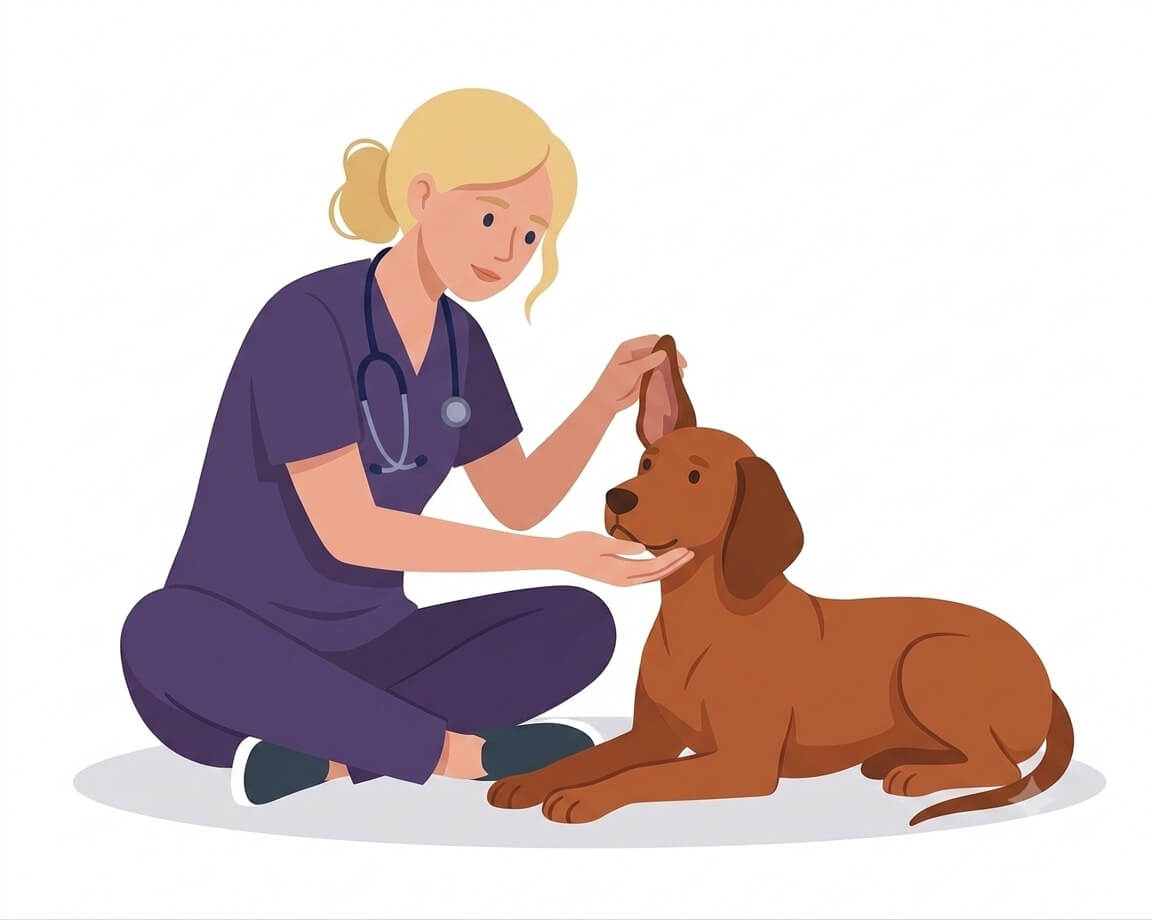
Your dog shakes its head several times a day, or your cat scratches at an ear until it’s red. It’s tempting to treat it as what it looks like: a dirty ear that needs a clean. Sometimes that’s exactly what it is.
But otitis — ear inflammation — is one of the most common reasons for a dermatology consult, and also one of the conditions most prone to becoming chronic. And that means precisely the opposite of what it looks like: it’s almost never “just” a dirty ear. In most cases there’s something behind it — an allergy, a parasite, excess moisture — keeping the problem going no matter how many times you clean it.
This guide covers the types of ear infection by the part of the ear affected, their most common causes, how to spot one in dogs and in cats, why it tends to come back, and what a proper diagnosis looks like. The goal: knowing when an irritated ear is a one-off, and when it’s worth a vet visit before it gets complicated.
The three types of ear infection by affected area
Not every ear infection is equally serious, and the main difference lies in how far the inflammation has spread.
- Otitis externa. Affects the external ear canal, the part visible from outside down to the eardrum. By far the most common, and usually the first one spotted.
- Otitis media. The infection or inflammation crosses the eardrum and reaches the middle ear. It’s almost always the result of an otitis externa that wasn’t treated in time, or was treated poorly — incompletely, or without identifying the real cause.
- Otitis interna. The most serious of the three. It affects structures responsible for balance and part of hearing, and can leave neurological after-effects: a permanent head tilt, hearing loss, balance problems that aren’t always reversible.
The same ear infection can start as otitis externa and, without proper treatment, progress to media or interna. That’s why when you step in matters as much as the treatment itself.
The three types of ear infection at a glance
| Type | Area affected | Frequency | Risk if untreated |
|---|---|---|---|
| Otitis externa | External ear canal, from the outside to the eardrum | By far the most common | Can progress to otitis media |
| Otitis media | Middle ear, beyond the eardrum | Less common; almost always from a mistreated external case | Can progress to otitis interna |
| Otitis interna | Balance structures and part of hearing | Least common and most serious | Neurological sequelae: head tilt, hearing loss, balance problems |
Why ear infections happen: the most common causes
Behind an ear infection there’s almost never a single cause, but a combination of factors reinforcing each other. Veterinary dermatologists tend to distinguish between what triggers the problem and what perpetuates it, and that distinction is key to understanding why some treatments work and others don’t.
Allergies. By far the most common trigger of chronic or recurring ear infections. Both atopic dermatitis and food allergy can show up in the ear exactly as they do on the skin — in fact, in many dogs and cats the ear is one of the first places the problem is noticed, even before generalised itching appears. If your pet has recurring ear infections with no clear parasitic or anatomical cause, an underlying allergy is suspect number one. Our guide on itching and skin allergies in dogs and cats explains in detail how these allergies are identified and why they tend to overlap with ear infections.
Parasites. The most relevant one is the mite Otodectes cynotis, which causes what’s known as ear mange. It’s especially common in kittens and in animals that have been in contact with feral cat colonies or other animals without parasite prevention, and it produces a very characteristic dark, granular discharge that resembles coffee grounds.
Secondary infections. Bacteria and yeasts — Malassezia being one of the most common — usually aren’t the root cause, but rather organisms that take advantage of an ear that’s already inflamed or damp to overgrow. That’s why treating only the infection, without addressing what’s favouring it, tends to bring improvement that lasts a few weeks and then comes back.
Excess moisture. Baths, swimming, very humid environments or warm climates create the perfect conditions for bacteria and yeasts to multiply inside the ear canal. It’s a factor that almost never causes an ear infection on its own, but it aggravates and perpetuates one very easily.
Anatomical factors. Floppy ears, narrow ear canals or canals with a lot of hair — typical of certain breeds — hinder the ear’s natural ventilation and make it easier for moisture and discharge to get trapped. They aren’t the underlying cause, but they explain why some pets are far more prone than others to developing an ear infection from the same trigger.
Symptoms in dogs
In dogs, an ear infection usually shows itself fairly clearly:
- Frequent head shaking, beyond the occasional shake after a bath or a walk
- Persistent scratching of the ear or the area around it
- A bad smell coming from the ear, sometimes noticeable without getting too close
- Visible discharge, ranging from yellowish to dark brown depending on the cause
- Pain when the area is touched: the animal pulls away, growls or whines when you try to examine the ear
- In more advanced cases, a head tilt toward the affected side or loss of balance
Those last two signs aren’t trivial. They usually indicate the inflammation has progressed beyond the outer ear, and they call for a vet visit without delay.
Symptoms in cats (more subtle, easy to miss)
As with many other feline conditions, ear infections in cats tend to show up more subtly than in dogs, which means they’re often spotted later.
- A mild head tilt, sometimes intermittent
- Occasional head shaking, less frequent or obvious than in dogs
- Scratching that, over time, can cause wounds and hair loss around the ear
- Non-specific behaviour changes: the cat avoids being touched on the head, becomes more irritable, or spends more time hiding
Many cat owners don’t connect these signs with an ear problem until the infection has already been going on for a while. If you notice any of these changes, along with other general signs of discomfort, our guide on signs your cat is sick can help you recognise when it’s worth booking an appointment.
Why ear infections come back if the underlying cause isn’t treated
This is probably the point that frustrates owners the most: “we treated it, and a few months later it’s back to the same thing.” The explanation is almost always the same. The infection or inflammation was treated as a one-off, but not what was causing it.
If the real trigger is an undiagnosed allergy, the ear will inflame again as soon as treatment is withdrawn, because the conditions favouring infection — more moisture, more inflammation, an environment more suited to bacteria and yeasts — are still there. It’s a self-feeding cycle: the allergy inflames the ear, the inflammation favours infection, and the infection generates even more inflammation.
That’s why a history of “ear infections that come and go” shouldn’t be treated as bad luck, but as a sign that the underlying cause still needs identifying. It’s exactly the same mechanism we describe for the skin in our article on itching and skin allergies: treating the symptom without treating the cause only buys time.
How it’s properly diagnosed
A proper diagnosis combines several steps, not a single test:
- A detailed history. When it started, whether it’s the first time or a recurrence, whether it follows a seasonal pattern, and what treatments have been tried before. This alone already tells the vet a great deal.
- Otoscopic examination. Allows the vet to assess the state of the ear canal, whether the eardrum is intact, whether there are foreign bodies, and the appearance and amount of discharge.
- Microscopic analysis of the discharge (cytology). A sample taken with a swab is examined under a microscope to identify whether bacteria, yeasts such as Malassezia, or parasites predominate. This step is what determines which type of treatment will actually be effective, and it’s why “trying a product” without a prior diagnosis usually fails or only helps temporarily.
- Culture with sensitivity testing, in specific cases: recurring ear infections, poor response to previous treatments, or very purulent discharge. It allows precise identification of the microorganism involved.
When the canal is already very inflamed or there’s significant pain, sedation is sometimes needed to complete the examination properly, without causing the animal unnecessary distress.
Prevention: how to reduce the risk
Not every ear infection can be prevented, but the risk can be reduced significantly:
- Check and dry your pet’s ears well after a bath or a swim, especially in breeds with floppy ears or narrow canals
- Pay extra attention if your dog or cat belongs to a breed predisposed by its ear anatomy
- If your pet already has a diagnosed allergy, keeping that allergy under control is, indirectly, the best ear-infection prevention there is
- Schedule regular ear checks during routine vet visits, especially if there’s been a previous episode
Frequently asked questions
Can I clean my dog’s or cat’s ears at home?
It depends on the context. As part of a hygiene routine, with no symptoms or active infection, it can be reasonable, and your vet can tell you whether it’s a good idea in your case and how often. But if there’s already a bad smell, discharge, pain or persistent scratching, cleaning the ear doesn’t fix anything underlying: it may make things look better for a couple of days, and it can also make later diagnosis harder by disturbing the sample the vet needs to examine.
Are ear infections contagious between pets?
Not always — it depends on the cause. When the cause is a parasite like Otodectes cynotis, it can spread between dogs and cats living together, and it’s common to need to check and treat every animal in the household. When the cause is an allergy, an anatomical factor or excess moisture, there’s no risk of contagion: it’s an individual problem for that animal.
Why does it keep coming back even though we treated it?
Almost always because the episode — the one-off infection or inflammation — was treated, but not the cause behind it. If there’s an undiagnosed allergy, an anatomically prone ear canal, or repeated exposure to moisture, the ear will inflame again as soon as the right conditions line up. A history of recurring ear infections is, in itself, a reason to investigate the underlying cause, not just to repeat the same treatment.
When is it an emergency?
Book an appointment as soon as possible, without waiting, if you notice a head tilt that doesn’t resolve, loss of balance, intense pain that stops you touching the area, noticeable swelling, or if your pet stops eating or seems very lethargic alongside the ear symptoms. These are signs the infection may have progressed beyond the outer ear, and the sooner it’s assessed, the lower the risk of lasting effects.
When to book an appointment to have your pet’s ear checked
A properly diagnosed and promptly treated ear infection usually resolves without major complications. The problem arises when it’s only addressed in parts — cleaning without diagnosing, treating the infection without treating the allergy — because then the cycle repeats, and the risk of it reaching the middle or inner ear grows with every relapse.
At Rovira Veterinary Clinic, Dr. Andrea Aldea, our specialist in Veterinary Dermatology with a postgraduate certification (GPCert), assesses every ear infection case individually, identifying the underlying cause rather than just the one-off episode, working alongside our feline medicine team whenever a case calls for it. If your dog or cat is shaking its head, scratching persistently at an ear, or you’ve noticed a bad smell, don’t wait for it to go away on its own: book an appointment and let’s give their ear the diagnosis it needs.
Sources
Do you have any questions about your pet?
Book an appointment