
 685 738 325

Dentistry
Dental cleaning for dogs and cats: why under anaesthesia and how often
20 October 2026

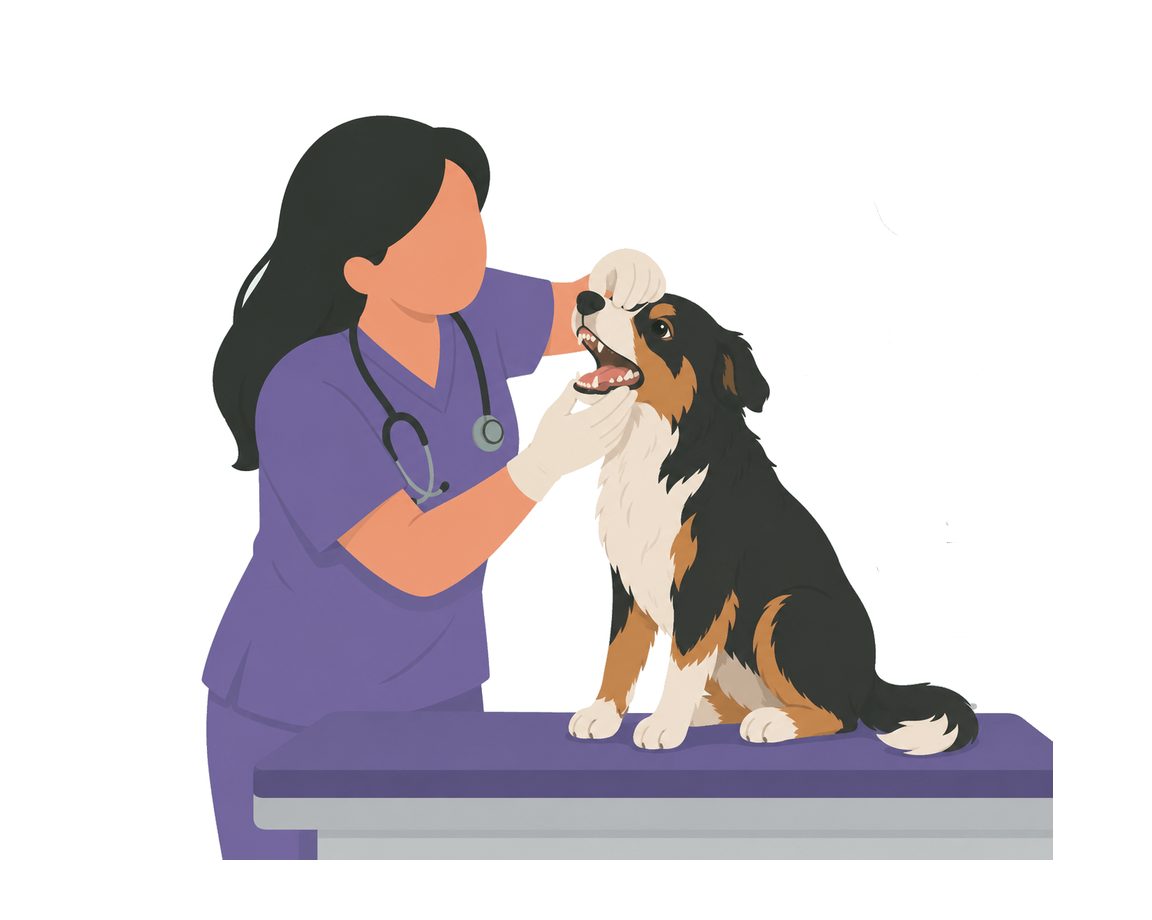
When we recommend a dental cleaning, we almost always get the same two questions: does cleaning teeth really need anaesthesia? And if so, how often will it have to be repeated?
They’re fair questions. For people, a dental cleaning is a half-hour appointment in the dentist’s chair. But a dog or a cat won’t open wide and sit still while we run an ultrasonic scaler under the gum, and that’s exactly where, out of sight, most of the disease is.
In this article we explain what periodontal disease is, why cleaning is done under anaesthesia, what it involves, how often it’s needed and what you can do at home to extend the time between cleanings.
Periodontal disease: the problem you can’t see
The most common dental disease in dogs and cats is periodontal disease: inflammation and destruction of the tissues that hold the tooth in place (gum, ligament and bone). It’s one of the most frequent conditions in small animal practice, and it affects most adult dogs and cats to some degree.
It starts with plaque, a soft bacterial film that forms on the teeth within hours of eating. If it isn’t removed, it mineralises into tartar, the yellow or brown crust you can see on the teeth. But visible tartar is the least of it. What matters is what’s happening below the gum line:
- Gingivitis. Bacteria inflame the gum, which turns red and bleeds easily. At this stage the damage is still reversible with a full cleaning.
- Periodontitis. The inflammation spreads towards the root, pockets form between the gum and the tooth, and bone starts to be lost. That bone doesn’t grow back.
- Advanced periodontitis. The tooth loses its attachment, becomes loose and painful. Often the only solution is to extract it.
Signs your dog or cat needs a dental check
- Persistent bad breath. It isn’t “just dog breath”: it almost always points to periodontal disease.
- Visible tartar, yellow or brown teeth, especially on the canines and upper back teeth.
- Red, swollen or bleeding gums, for example when chewing toys.
- Chewing on one side, dropping food or preferring wet food.
- Excessive drooling or pawing at the face.
- Loose, broken teeth or teeth with exposed pulp.
Why dental cleaning is done under anaesthesia
This is the part owners find hardest to accept, so let’s take it step by step. Anaesthesia isn’t used for the sake of it: it’s what makes the cleaning actually work.
- To clean below the gum line. The cleaning that treats the disease is subgingival, in the pockets between the gum and the root. It’s uncomfortable, needs fine instruments and requires the animal to be completely still.
- To examine the mouth tooth by tooth. With the animal asleep we can measure the depth of the pockets around every tooth with a probe, see the inner surfaces (facing the tongue and palate) and pick up loose teeth, fractures or lesions that go unnoticed in an awake animal.
- To protect the airways. Water is used to cool the ultrasonic scaler, and tartar and bacteria are released during cleaning. With the animal intubated, none of that reaches the lungs.
- So it doesn’t suffer. Cleaning under inflamed gums hurts, and restraining a conscious animal for as long as it takes is stressful and dangerous for it.
What about anaesthesia-free cleanings?
They exist, and they’re sometimes offered at groomers or pet spas. They scrape tartar off the visible surface of the tooth and the result looks good: the teeth come out white. But they don’t treat what’s under the gum, which is the actual disease, and they leave the tooth surface scratched, so plaque builds up again faster.
The main veterinary dental organisations, such as the American Veterinary Dental College and the WSAVA dental committee, explicitly advise against these cleanings. The risk isn’t only that they don’t work: they give a false impression of a healthy mouth while periodontitis keeps progressing underneath.
What a full dental cleaning involves
A proper dental cleaning is a structured procedure, not just “removing tartar”:
- Pre-procedure check and blood tests. Before scheduling it we examine the mouth with the animal awake (as far as it allows) and run a pre-anaesthetic blood test to tailor the anaesthesia to its health.
- Anaesthesia and monitoring. With a protocol adapted to the animal and continuous monitoring of its vital signs, just like any other surgery. To learn more, see our guide to veterinary anaesthesia.
- Tartar removal with ultrasound, above and below the gum line.
- Probing and examination of every tooth: pockets, mobility, fractures, lesions.
- Polishing. It smooths the tooth surface so plaque sticks to it more slowly. It’s a step that shouldn’t be skipped.
- Extractions, if needed. Teeth that can no longer be saved because of mobility, fracture or bone loss are removed to get rid of the pain and the source of infection.
Cats are a special case
As well as periodontal disease, cats have two dental problems of their own:
- Tooth resorption. The body gradually destroys the tooth from the inside. It’s very common in adult cats, very painful, and often shows up only as a small bump of gum over the tooth, or not at all. Treatment is usually extraction.
- Feline chronic gingivostomatitis. Severe, very painful inflammation of the gums and mouth that needs specific treatment and sometimes extensive extractions.
If your cat has bad breath, drools or has changed the way it eats, it’s worth having its mouth checked. These are among the signs of a sick cat that most often go unnoticed.
How often to have a dental cleaning
There’s no single number that works for everyone. How often depends on the animal’s predisposition and on the care it gets at home:
| Animal | Typical interval |
|---|---|
| Small and toy breeds (Yorkshire, Chihuahua, Bichon, Poodle, Pomeranian) | Often yearly from the age of 2-3 |
| Flat-faced breeds (French Bulldog, Pug, Shih Tzu) | Often yearly: crowded teeth trap more plaque |
| Cats | Variable; yearly check for tartar, gingivitis and resorption |
| Medium and large dogs with good home care | Every 2-3 years, or even less often |
What is fixed is checking the mouth at every annual visit. Based on what we see, we decide whether a cleaning is due now or can wait. Waiting until there’s a lot of tartar doesn’t save anything: the cleaning takes longer, extractions become more likely and the animal spends longer in pain.
As a rule of thumb, it’s better to clean at the gingivitis stage, when everything is still reversible, than at the periodontitis stage, when bone has already been lost.
What the cost of a dental cleaning depends on
It’s one of the most common searches, and we understand why: it’s hard to know in advance how much it’ll cost. The price depends on:
- The animal’s size, which affects anaesthesia and medication.
- Its age and health, which determine the pre-anaesthetic tests it needs.
- The state of the mouth: a cleaning with little tartar and healthy gums is shorter than one with advanced periodontitis.
- Whether extractions are needed, how many, and whether they involve multi-rooted teeth, which take more work.
That’s why, before scheduling it, we examine the mouth and give you a quote. And if something comes up during the cleaning that couldn’t be seen with the animal awake, such as a tooth fractured below the gum or a resorptive lesion, we call you to explain and decide together before doing anything.
How to care for your dog’s or cat’s teeth at home
A professional cleaning removes tartar, but plaque starts forming again within hours. Home care is what decides whether the next cleaning will be in one year or in three:
- Tooth brushing. By far the most effective measure. Ideally daily, with a brush or finger brush and veterinary toothpaste (human toothpaste must not be swallowed). It’s easiest to start as a puppy or kitten, but adults can learn too if you go slowly and use rewards. If you’re starting out with a puppy or kitten, we’ll go over it at the first vet visit.
- Dental chews, diets and toys. They help, but they don’t replace brushing. Look for products with the VOHC seal (Veterinary Oral Health Council), which certifies they’ve been shown to reduce plaque or tartar.
- Avoid bones, antlers and very hard toys. They’re a common cause of broken teeth, especially the large upper back teeth.
- Look in its mouth now and then. Lift the lip and check the canines and back teeth: tooth colour, gums, smell. You’ll soon notice if something changes.
Frequently asked questions
Why does my dog’s or cat’s dental cleaning have to be under anaesthesia?
Because dental disease lies mainly below the gum line, and that area can only be cleaned and examined with the animal asleep and still. Anaesthesia also allows us to intubate, so the water and bacteria released during cleaning don’t reach the airways. An anaesthesia-free cleaning only removes visible tartar and leaves the real problem untreated.
Is anaesthesia for a dental cleaning dangerous?
In a healthy animal the anaesthetic risk is low, and it’s reduced further with pre-anaesthetic blood tests, a tailored protocol and continuous monitoring. Older animals or those with medical conditions are assessed in more detail before scheduling. Leaving periodontal disease untreated has a cost too: chronic pain, infection and tooth loss.
Can it eat after the cleaning?
It usually goes home the same day and can eat a small meal that evening. If teeth have been extracted, we’ll recommend a few days of soft or wet food and pain relief. Animals adapt very well to eating without the extracted teeth, because those were precisely the ones that hurt.
My dog is very old. Is it still worth it?
Age alone isn’t a reason not to do it. An older dog or cat with an infected, painful mouth usually gains a lot of quality of life from a cleaning. What changes is the pre-procedure assessment, which is more thorough, and the anaesthetic protocol, which is adapted to its condition.
When to book an appointment
- Your dog or cat has bad breath or you can see tartar on its teeth.
- Its gums bleed, it chews strangely or it has changed the way it eats.
- It’s a small or flat-faced breed and has never had its mouth checked.
- It’s been more than a year since its last dental check.
At Clínica Veterinaria Rovira, in Gràcia, we carry out dental cleanings and tooth extractions under anaesthesia, with pre-anaesthetic blood tests and continuous monitoring. Take a look at our veterinary dentistry service or book an appointment so we can check your dog’s or cat’s mouth.
Sources
Do you have any questions about your pet?
Book an appointment